Maxfusion AI vs. HeyGen 2026: Pricing, Models and Which One Is Built for Ads
Ori Silver
·
Co-founder, Maxfusion AI
·
HeyGen and Maxfusion AI both turn a script and a face into a talking video, and both run third party video models such as Seedance 2.0 and Veo 3.1.
The two platforms were built for different jobs.
HeyGen is an avatar platform: explainer videos, training, sales outreach and translated presentations, priced per minute of talking head output.
Maxfusion AI is an ad production platform: research, generation, actors, finishing and delivery for teams that ship paid social at volume.
This article compares the two on business plans, on the models each one runs, and on what a month of credits produces, using the live published pricing of both platforms as of October 2026.
How this comparison works. Maxfusion AI is built for businesses: creative strategists, editors and media buyers working in one account.
So this article compares business plans only, the plans a production team actually buys.
The same method covers Higgsfield, Arcads, OpenArt and Magnific on the Maxfusion comparison page.
HeyGen Business costs $149 a month for one seat and 1,500 credits. Every extra seat costs $20 and adds no credits.
Maxfusion AI Pro costs $199 a month with 4,500 credits, and Maxfusion AI Max costs $400 with 10,000 credits. Both include unlimited seats.
HeyGen publishes credit prices for two of its generator models, Seedance 2.0 and Veo, and for its avatar minutes. Those are the rows a team can count, so those are the rows below.
Key takeaways
HeyGen is strong at explainer and talking head videos. Its site names marketing, sales, learning and explainers as its work, and the ad tools are absent: no ad research, no competitor tracking, no swipe files, no content analyzer and no canvas for bulk production.
On the models both platforms price, the same budget produces 42% to 145% more videos on Maxfusion AI Max, and 28% to 123% more on Pro.
HeyGen Business holds 1,500 credits a month. Fifteen Seedance 2.0 clips at 1080p use all of them.
Maxfusion AI runs the ad models HeyGen does not sell: Kling 3.0 Pro, MiniMax H3 and H3 Max, Flux 3, Seedance 1.5 Pro, and RIZZ, its own audio-driven model for UGC performances up to five minutes long.
HeyGen sells one seat and charges $20 for each extra one. Every Maxfusion AI Pro and Max plan includes unlimited seats.
What is the difference?
Maxfusion AI is the creative layer for agencies and brands that produce ads at volume.
Research, generation and finishing share one workspace: competitor ads come in through the Research Lab, Flows chains them into repeatable pipelines, and agents like Claude and Codex run the whole platform through its MCP.
Skills trained on tens of thousands of ads take a product to a finished ad in realistic UGC, claymation, Pixar-style animation, singing ads and whatever format the next campaign demands.
HeyGen describes itself with one line: AI videos starring you, made in minutes. Its products are Avatar V, the Video Agent, AI Studio, Video Translation in more than 175 languages and LiveAvatar, and its site names marketing, sales, learning and explainer videos as the work it is built for.
That is a presenter platform, and a good one: a consistent avatar, a text based editor and translation with lip sync.
An ad team needs something else: dozens of distinct creatives a month, built from winning competitor ads, across formats that reach far beyond a presenter talking to camera.
That difference in purpose shows in the models below, in the numbers and in the tools around them.
The models each platform runs
An ad team lives on the model catalog, because the format of the next winning ad is unknown until it is tested.
HeyGen’s AI Video Generator lists Seedance 2.5, Seedance 2.0, Seedance 2.0 Mini, Gemini Omni Flash, Wan 3 and Veo 3.1 next to its own HeyGen Video model, and publishes credit prices for Seedance 2.0 and Veo only.
Maxfusion AI runs those and the rest of the field, with a published credit price on every one of them.
Video model | Maxfusion AI | HeyGen |
|---|---|---|
Seedance 2.5 | ✓ | ✓ (no public price) |
Seedance 2.0 | ✓ | ✓ |
Seedance 2.0 Mini | ✓ | ✓ (no public price) |
Seedance 1.5 Pro | ✓ | ✗ |
Veo 3.1 | ✓ | ✓ |
Veo 3.1 Lite | ✓ | ✗ |
Wan 3.0 and Wan 3.0 Prime | ✓ | Wan 3 (no public price) |
Google Omni Flash 1.1 | ✓ | ✓ (no public price) |
MiniMax H3 and H3 Max | ✓ | ✗ |
Kling 3.0 Pro and Kling 2.6 | ✓ | ✗ |
Flux 3 | ✓ | ✗ |
RIZZ, audio-driven UGC up to 5 minutes | ✓ | ✗ |
Audio-driven photo avatars | ✓ (OmniHuman 1.5, RIZZ) | ✓ (Avatar IV photo look) |
Own model | RIZZ | HeyGen Video |
Shared models: what both platforms give you for videos
Both platforms price generation in credits, and a credit is worth a different amount of money on each.
The honest measure is what a real plan produces.
Here the two entry business plans sit side by side: Maxfusion AI Pro at $199 a month with 4,500 credits, against HeyGen Business at $149 a month with 1,500 credits and one seat.
Each cell counts the videos one month of credits buys, on 10 second clips (8 seconds on Veo 3.1) and on talking actor videos of one to two minutes. The bracket is the lead: how many more videos Pro produces than HeyGen Business.
Model | Pro ($199/mo) | HeyGen ($149/mo) |
|---|---|---|
Seedance 2.0 (720p) | 64 (+73%) | 37 |
Seedance 2.0 (1080p) | 32 (+113%) | 15 |
Veo 3.1 (1080p, 8s) | 48 (+200%) | 16 |
Talking Actors video (60 to 120s) | 45 (+88%) | 24 |
RIZZ audio-driven avatar (60s) | 36 | ✗ |
Plans compared
Maxfusion AI Pro | Maxfusion AI Max | HeyGen Business, 1 seat | HeyGen Business, 5 seats | |
|---|---|---|---|---|
Monthly price | $199 | $400 | $149 | $229 |
Credits per month | 4,500 | 10,000 | 1,500 | 1,500 |
Seats | Unlimited | Unlimited | 1 | 5 |
Seedance 2.0 videos (10s, 720p) | 64 | 142 | 37 | 37 |
Seedance 2.0 videos (10s, 1080p) | 32 | 71 | 15 | 15 |
Veo 3.1 videos (8s, 1080p) | 48 | 108 | 16 | 16 |
Talking Actors videos (60 to 120s) | 45 | 100 | 24 | 24 |
RIZZ videos (60s) | 36 | 80 | ✗ | ✗ |
HeyGen’s credits are an expensive unit. The Business plan holds 1,500 of them, which is fifteen Seedance 2.0 clips at 1080p or thirty seven at 720p, and then the month is over.
Seats add nothing to the pool: a five person team pays $229 a month for the same 1,500 credits.
Credits are a unit each platform defines for itself. Videos per month per dollar decides a production budget, and that has its own table.
Dollar for dollar: Maxfusion AI vs. HeyGen
What $200 a month buys you in video generations, Maxfusion AI Pro against HeyGen Business, with the lead in brackets.
Model | Pro ($200) | HeyGen ($200) |
|---|---|---|
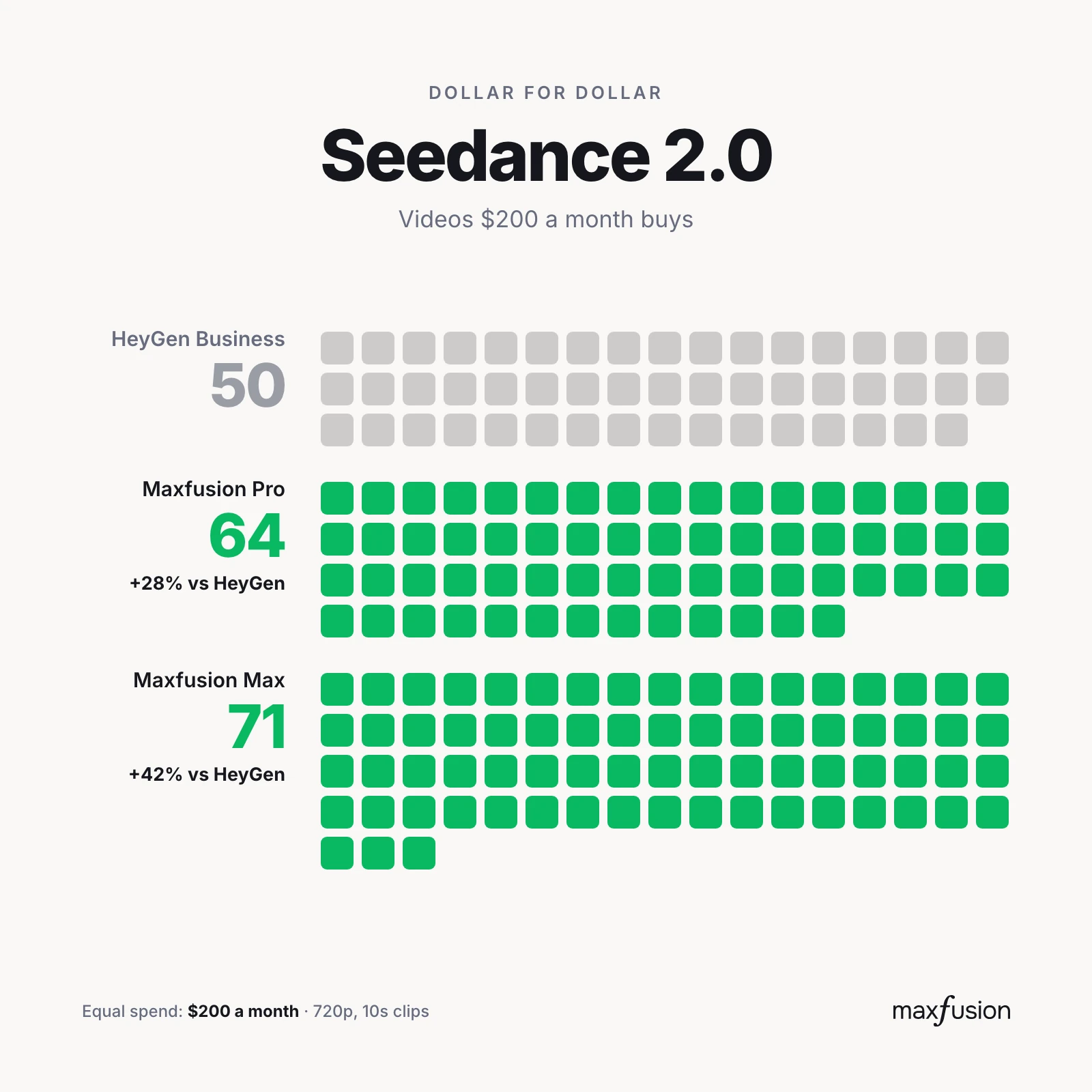
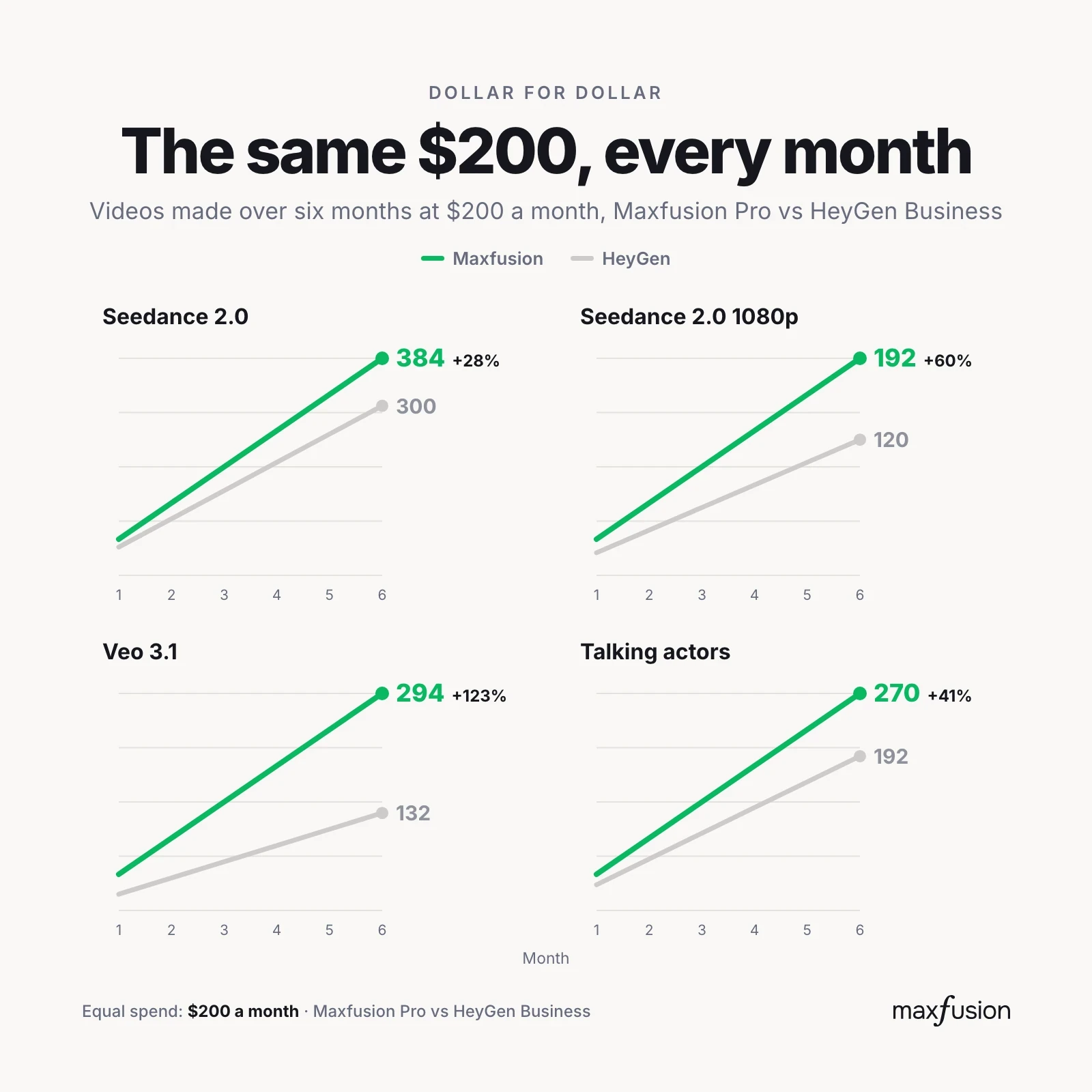
Seedance 2.0 (720p) | 64 (+28%) | 50 |
Seedance 2.0 (1080p) | 32 (+60%) | 20 |
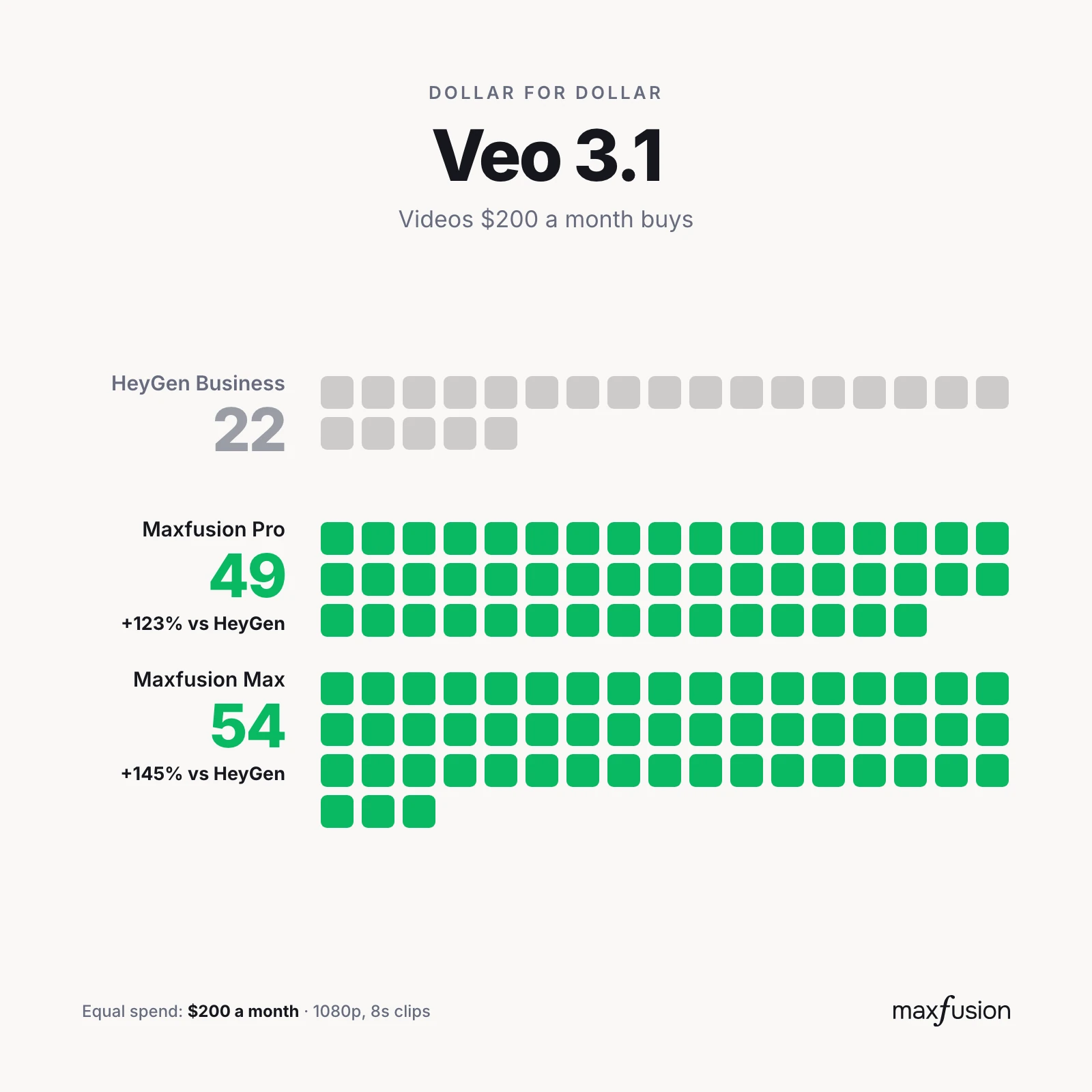
Veo 3.1 (1080p, 8s) | 49 (+123%) | 22 |
Talking Actors video (60 to 120s) | 45 (+41%) | 32 |
RIZZ audio-driven avatar (60s) | 36 | ✗ |
The same $200 on Maxfusion AI Max against HeyGen Business:
Model | Max ($200) | HeyGen ($200) |
|---|---|---|
Seedance 2.0 (720p) | 71 (+42%) | 50 |
Seedance 2.0 (1080p) | 35 (+75%) | 20 |
Veo 3.1 (1080p, 8s) | 54 (+145%) | 22 |
Talking Actors video (60 to 120s) | 50 (+56%) | 32 |
RIZZ audio-driven avatar (60s) | 40 | ✗ |
These tables hold spend at exactly $200 a month in every column, so the only variable left is how many credits each platform charges for one video.
Maxfusion AI moves the other way: Pro buys about 22.6 credits per dollar and Max buys 25, so the lead grows with the plan.
Is HeyGen built for ads?
HeyGen’s own site answers that. Its use cases are marketing videos, sales outreach, learning and training, explainers and social content, with a presenter at the centre of each.
Paid social runs on a different loop: find what works in the Meta Ad Library, rebuild it in your own formats, ship dozens of variants, keep the winners.
HeyGen has no Meta Ad Library search, no TikTok or Instagram research, no competitor tracking, no swipe files and no content analyzer.
It has no canvas for bulk pipelines either. Its MCP and API cover avatars, templates, translation and batches rather than research or composition, and the API is sold apart from the subscription, with its own wallet.
Maxfusion AI starts from the ad. The Research Lab brings winning ads in, skills rebuild them as UGC, product in hand, claymation or singing formats, Flows turns the process into a pipeline that runs in bulk, and the compositor, captions and text overlays finish each variant in the same workspace.
What only Maxfusion AI has
RIZZ. Maxfusion AI’s own audio-driven model for talking head UGC.
You give it audio and a starting frame, and it builds the performance around the delivery: lip sync, timing and expression driven by the sound itself, in clips up to five minutes long on the Max plan. It is tuned for the energy of a UGC ad rather than a presenter at a desk.
The Research Lab. Meta Ad Library search, TikTok and Instagram search, a content analyzer that breaks any ad into hook, script and shots, nightly competitor tracking that flags new and stopped ads, and swipe files the whole team shares.
The model catalog. Kling 3.0 Pro, MiniMax H3 and H3 Max, Flux 3 and Seedance 1.5 Pro, each with a published price, next to the models both platforms carry.
Flows and bulk pipelines. An open canvas chains research, generation, captions and text overlays into a pipeline you build once and run in bulk across a batch of products or hooks. HeyGen’s Batch Mode produces many single scene avatar videos from a list, and stops there.
The full MCP toolkit. Every tool on Maxfusion AI is open to any AI agent over MCP: research, analysis, generation and composition. Claude, ChatGPT, Codex, Cursor or whichever agent a team already runs handles the whole job, from research to the finished ad.
A plan built for a whole team. Pro and Max include unlimited seats, free unlimited image generations, a usage dashboard with per member controls, a Google Drive connector, and Asana, ClickUp and Notion connectors that read briefs and post finished work back. HeyGen Business includes one seat and charges $20 for each extra one, with no usage controls per member.
What only HeyGen has
Avatar V and a consistent digital twin. Record once, and HeyGen keeps one identity across every video, with expressions and angles that hold up over a long presentation. For a weekly training video or a translated keynote, that is the right tool.
Video Translation and LiveAvatar. Translation into more than 175 languages with voice cloning and lip sync, and a real time avatar for live sessions. Maxfusion AI translates and dubs into other languages as well, and leaves real time avatars to HeyGen.
A text based editor for presentations. AI Studio edits a presenter video like a document, which suits explainers and courses.
Is HeyGen expensive compared to Maxfusion AI for ad teams?
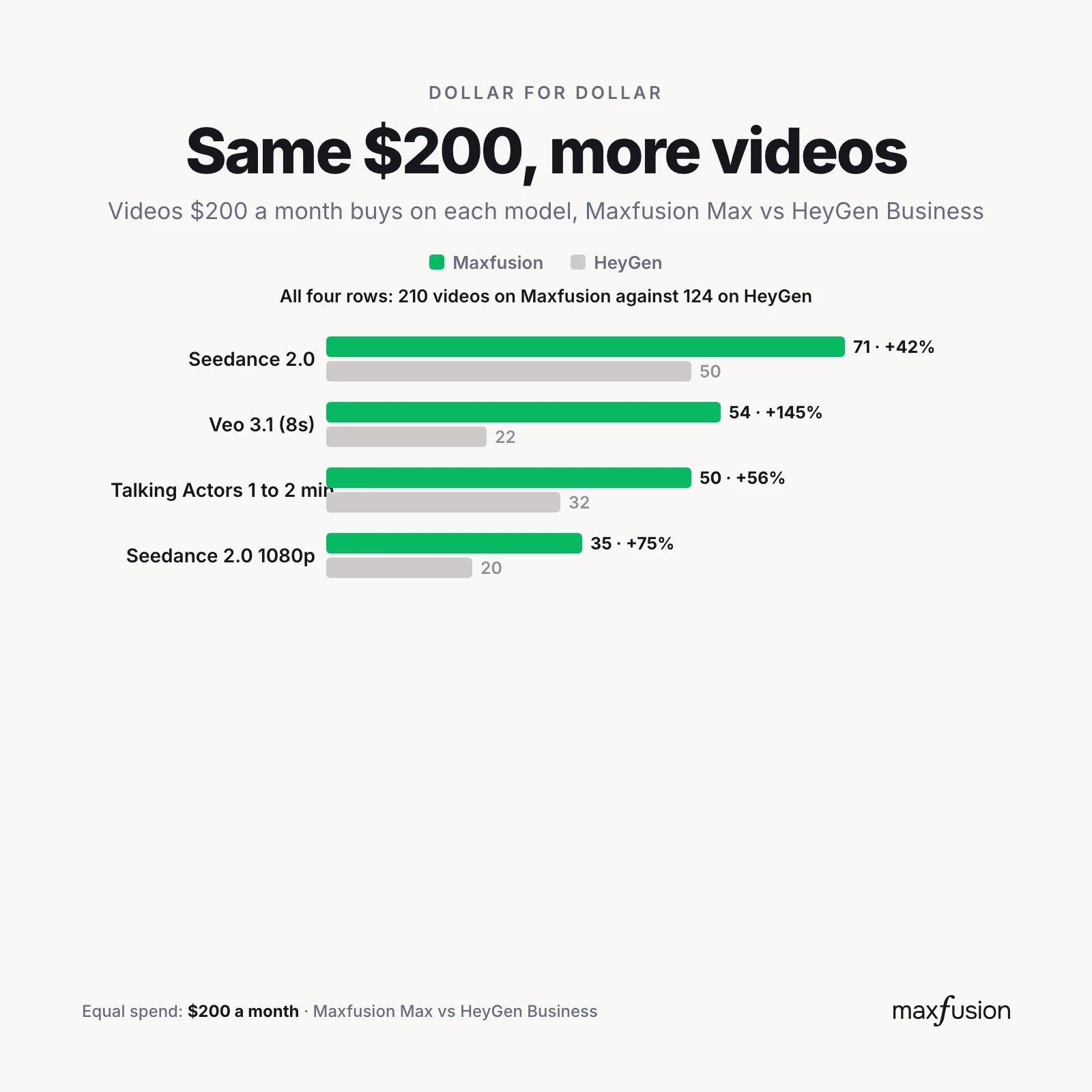
On the models HeyGen prices, yes. The same monthly budget buys fewer videos on HeyGen Business on every row in this comparison.
Seedance 2.0 at 1080p gives Maxfusion AI Pro 32 clips a month against 15 on HeyGen Business, and Veo 3.1 reaches 48 against 16.
Talking videos of one to two minutes tell the same story: 45 on Pro and 100 on Max against 24 on HeyGen Business.
HeyGen prices avatar clips and translation by the minute, which suits a presenter video and says nothing about an ad campaign of forty variants.
The value question for teams that need to scale
Ads in 2026 run on volume.
Since Meta’s Andromeda update, accounts win on creative diversity: the algorithm rewards many distinct creatives across angles and formats, and one polished hero video no longer carries a budget.
A team shipping 15 ads a month is guessing. Teams that win ship dozens of variants, learn what survives and feed the winners back into production.
Run that volume through the numbers above. A team on Maxfusion AI Pro gets 64 Seedance 2.0 clips at 720p a month, and HeyGen Business buys 37.
Step up to Max and the month holds 142 Seedance 2.0 clips, 108 Veo 3.1 clips and 100 talking actor videos, with every strategist, editor and media buyer on the account at no extra seat cost.
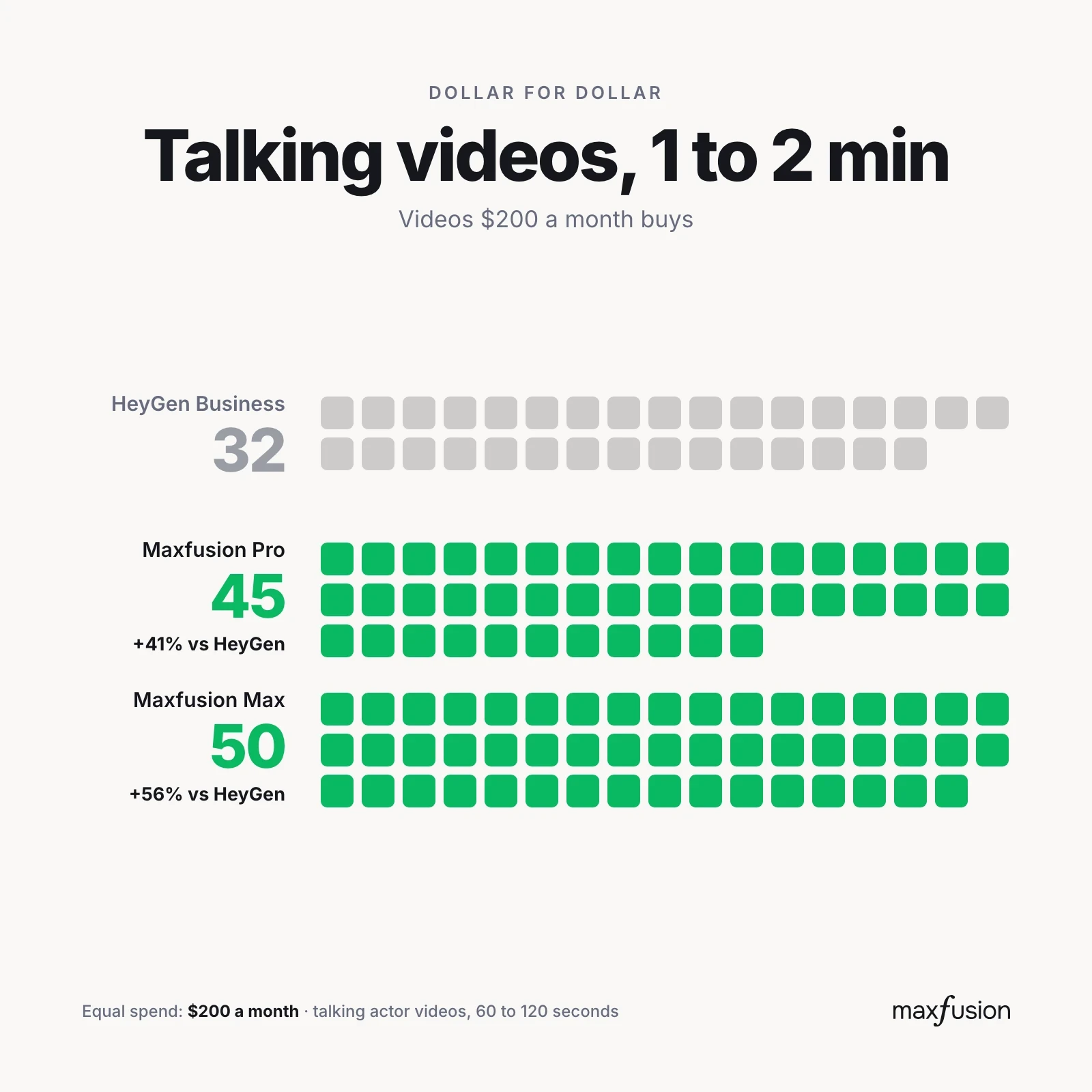
Both platforms make good talking videos. For diversity at volume, with new angles, hooks and formats tested before creative fatigue sets in, Maxfusion AI hands a team more finished videos for the same money every month, on models HeyGen does not run.
At that point the choice stops being a preference and becomes arithmetic.
Who actually benefits from each platform?
Choose Maxfusion AI if:
Ads are the job, and every dollar has to turn into more finished videos.
Competitor research belongs next to production in your workflow.
AI agents like Claude or Codex already run part of your work and need the full platform behind them.
Formats range from realistic UGC and talking heads to claymation and singing ads, with skills built for each.
The team keeps growing, and a price per seat would get in the way.
Choose HeyGen if:
A presenter is the format: training, onboarding, explainers and sales videos with one consistent avatar.
Translation into many languages with lip sync is the core job.
Live avatar sessions belong in your workflow.
Maxfusion AI or HeyGen: which one is right for your workflow?
HeyGen is a strong avatar platform, and for explainer and talking videos it does its job well.
For a team that produces ads at volume, Maxfusion AI is the HeyGen alternative built for the job: the full model catalog with published prices, RIZZ for UGC performances up to five minutes, research and bulk production in one workspace, and unlimited seats.
If ads are what you ship, the arithmetic in this article points one way.
Compare every platform side by side
The Maxfusion comparison page lines up Higgsfield, Arcads, OpenArt, Magnific and HeyGen against Maxfusion on matching models and budgets, with a capability table that covers research, production, finishing and automation.
Choose a budget and a model, and it shows how many finished videos each platform delivers.
Head-to-head breakdowns: Maxfusion AI vs Higgsfield AI, Maxfusion AI vs Arcads AI, Maxfusion AI vs OpenArt AI and Maxfusion AI vs Magnific. Plans and prices for every Maxfusion tier are on the pricing page.
" height="57.25593113035147px" id="pFbN4t6nI" transform="translate(73 0)" width="138.9190010986328px"/><path d="M 58.958 24.529 L 67.611 12.149 L 59.372 0.274 L 64.067 0.274 L 70.234 9.479 L 76.217 0.274 L 80.774 0.274 L 72.58 12.287 L 81.37 24.529 L 76.723 24.529 L 70.003 15.279 L 63.375 24.529 L 58.957 24.529 Z M 44.566 24.809 C 43.479 24.811 42.396 24.671 41.345 24.394 C 40.359 24.1 39.426 23.649 38.583 23.059 C 37.789 22.45 37.131 21.682 36.65 20.804 C 36.19 19.884 35.96 18.824 35.96 17.628 C 35.96 16.248 36.205 15.082 36.696 14.13 C 37.218 13.18 37.908 12.427 38.768 11.875 C 39.627 11.323 40.624 10.924 41.759 10.679 C 42.924 10.43 44.112 10.306 45.303 10.31 L 52.437 10.31 C 52.437 8.93 52.237 7.733 51.838 6.72 C 51.47 5.708 50.857 4.926 49.998 4.373 C 49.138 3.79 48.003 3.499 46.592 3.499 C 45.786 3.493 44.982 3.585 44.198 3.775 C 43.462 3.959 42.833 4.251 42.311 4.649 C 41.79 5.049 41.406 5.585 41.161 6.26 L 36.972 6.26 C 37.187 5.156 37.602 4.22 38.215 3.453 C 38.848 2.664 39.63 2.008 40.516 1.52 C 41.436 0.998 42.419 0.615 43.462 0.37 C 44.487 0.126 45.538 0.002 46.592 0 C 50.09 0 52.575 1.029 54.048 3.085 C 55.52 5.14 56.257 7.917 56.257 11.415 L 56.257 24.532 L 52.989 24.532 L 52.759 21.448 C 52.084 22.368 51.271 23.075 50.319 23.565 C 49.397 24.047 48.402 24.373 47.374 24.532 C 46.449 24.711 45.509 24.803 44.566 24.808 Z M 44.935 21.356 C 46.469 21.356 47.788 21.111 48.893 20.62 C 50.028 20.098 50.903 19.347 51.516 18.365 C 52.13 17.383 52.436 16.186 52.436 14.775 L 52.436 13.578 L 48.156 13.578 C 47.144 13.578 46.146 13.593 45.165 13.624 C 44.183 13.654 43.293 13.778 42.495 13.992 C 41.698 14.207 41.053 14.575 40.562 15.097 C 40.102 15.618 39.872 16.37 39.872 17.352 C 39.872 18.272 40.102 19.024 40.562 19.607 C 41.053 20.19 41.682 20.635 42.449 20.942 C 43.249 21.218 44.089 21.358 44.935 21.356 Z M 0 24.532 L 0 0.277 L 3.774 0.277 L 3.958 3.177 C 4.48 2.44 5.063 1.842 5.707 1.382 C 6.381 0.922 7.128 0.58 7.917 0.369 C 8.769 0.12 9.652 -0.004 10.54 0.001 C 12.227 0.001 13.593 0.369 14.636 1.105 C 15.669 1.799 16.483 2.773 16.983 3.913 C 17.505 3.119 18.141 2.405 18.87 1.796 C 19.602 1.216 20.427 0.764 21.31 0.461 C 22.23 0.154 23.242 0.001 24.347 0.001 C 26.127 0.001 27.553 0.384 28.627 1.151 C 29.732 1.919 30.53 2.961 31.02 4.281 C 31.511 5.57 31.757 7.027 31.757 8.653 L 31.757 24.532 L 27.845 24.532 L 27.845 10.632 C 27.845 9.835 27.799 9.022 27.707 8.193 C 27.654 7.4 27.467 6.622 27.154 5.892 C 26.848 5.156 26.387 4.572 25.774 4.143 C 25.191 3.683 24.362 3.453 23.288 3.453 C 22.276 3.453 21.417 3.698 20.711 4.189 C 20.036 4.649 19.484 5.279 19.054 6.076 C 18.621 6.885 18.311 7.754 18.134 8.654 C 17.95 9.544 17.858 10.434 17.858 11.323 L 17.858 24.532 L 13.945 24.532 L 13.945 10.586 C 13.945 9.819 13.899 9.022 13.807 8.193 C 13.755 7.405 13.584 6.629 13.301 5.892 C 13.076 5.183 12.623 4.568 12.012 4.143 C 11.429 3.683 10.616 3.453 9.573 3.453 C 8.1 3.453 6.95 3.883 6.121 4.741 C 5.293 5.57 4.71 6.598 4.372 7.825 C 4.07 8.982 3.916 10.173 3.912 11.369 L 3.912 24.532 Z" fill="rgb(21, 22, 27)" height="24.80901853219235px" id="Dy5HPNSvH" transform="translate(0 18.5)" width="81.37000073242189px"/></g></svg>)
" height="32px" id="VmykzZzNe" width="32px"/></svg>)
" height="30.633213969252477px" id="w5KefWMGh" transform="translate(0 1)" width="32px"/></svg>)
" height="32px" id="KxxfrbxU7" width="32px"/></g></svg>)
" height="22.41686631528509px" id="wfz7J8dwQ" transform="translate(0 5)" width="32px"/></svg>)
" height="57.25593113035147px" id="ZNNxR3481" transform="translate(73 0)" width="138.9190010986328px"/><path d="M 58.958 24.529 L 67.611 12.149 L 59.372 0.274 L 64.067 0.274 L 70.234 9.479 L 76.217 0.274 L 80.774 0.274 L 72.58 12.287 L 81.37 24.529 L 76.723 24.529 L 70.003 15.279 L 63.375 24.529 L 58.957 24.529 Z M 44.566 24.809 C 43.479 24.811 42.396 24.671 41.345 24.394 C 40.359 24.1 39.426 23.649 38.583 23.059 C 37.789 22.45 37.131 21.682 36.65 20.804 C 36.19 19.884 35.96 18.824 35.96 17.628 C 35.96 16.248 36.205 15.082 36.696 14.13 C 37.218 13.18 37.908 12.427 38.768 11.875 C 39.627 11.323 40.624 10.924 41.759 10.679 C 42.924 10.43 44.112 10.306 45.303 10.31 L 52.437 10.31 C 52.437 8.93 52.237 7.733 51.838 6.72 C 51.47 5.708 50.857 4.926 49.998 4.373 C 49.138 3.79 48.003 3.499 46.592 3.499 C 45.786 3.493 44.982 3.585 44.198 3.775 C 43.462 3.959 42.833 4.251 42.311 4.649 C 41.79 5.049 41.406 5.585 41.161 6.26 L 36.972 6.26 C 37.187 5.156 37.602 4.22 38.215 3.453 C 38.848 2.664 39.63 2.008 40.516 1.52 C 41.436 0.998 42.419 0.615 43.462 0.37 C 44.487 0.126 45.538 0.002 46.592 0 C 50.09 0 52.575 1.029 54.048 3.085 C 55.52 5.14 56.257 7.917 56.257 11.415 L 56.257 24.532 L 52.989 24.532 L 52.759 21.448 C 52.084 22.368 51.271 23.075 50.319 23.565 C 49.397 24.047 48.402 24.373 47.374 24.532 C 46.449 24.711 45.509 24.803 44.566 24.808 Z M 44.935 21.356 C 46.469 21.356 47.788 21.111 48.893 20.62 C 50.028 20.098 50.903 19.347 51.516 18.365 C 52.13 17.383 52.436 16.186 52.436 14.775 L 52.436 13.578 L 48.156 13.578 C 47.144 13.578 46.146 13.593 45.165 13.624 C 44.183 13.654 43.293 13.778 42.495 13.992 C 41.698 14.207 41.053 14.575 40.562 15.097 C 40.102 15.618 39.872 16.37 39.872 17.352 C 39.872 18.272 40.102 19.024 40.562 19.607 C 41.053 20.19 41.682 20.635 42.449 20.942 C 43.249 21.218 44.089 21.358 44.935 21.356 Z M 0 24.532 L 0 0.277 L 3.774 0.277 L 3.958 3.177 C 4.48 2.44 5.063 1.842 5.707 1.382 C 6.381 0.922 7.128 0.58 7.917 0.369 C 8.769 0.12 9.652 -0.004 10.54 0.001 C 12.227 0.001 13.593 0.369 14.636 1.105 C 15.669 1.799 16.483 2.773 16.983 3.913 C 17.505 3.119 18.141 2.405 18.87 1.796 C 19.602 1.216 20.427 0.764 21.31 0.461 C 22.23 0.154 23.242 0.001 24.347 0.001 C 26.127 0.001 27.553 0.384 28.627 1.151 C 29.732 1.919 30.53 2.961 31.02 4.281 C 31.511 5.57 31.757 7.027 31.757 8.653 L 31.757 24.532 L 27.845 24.532 L 27.845 10.632 C 27.845 9.835 27.799 9.022 27.707 8.193 C 27.654 7.4 27.467 6.622 27.154 5.892 C 26.848 5.156 26.387 4.572 25.774 4.143 C 25.191 3.683 24.362 3.453 23.288 3.453 C 22.276 3.453 21.417 3.698 20.711 4.189 C 20.036 4.649 19.484 5.279 19.054 6.076 C 18.621 6.885 18.311 7.754 18.134 8.654 C 17.95 9.544 17.858 10.434 17.858 11.323 L 17.858 24.532 L 13.945 24.532 L 13.945 10.586 C 13.945 9.819 13.899 9.022 13.807 8.193 C 13.755 7.405 13.584 6.629 13.301 5.892 C 13.076 5.183 12.623 4.568 12.012 4.143 C 11.429 3.683 10.616 3.453 9.573 3.453 C 8.1 3.453 6.95 3.883 6.121 4.741 C 5.293 5.57 4.71 6.598 4.372 7.825 C 4.07 8.982 3.916 10.173 3.912 11.369 L 3.912 24.532 Z" fill="rgb(41, 42, 47)" height="24.80901853219235px" id="MB0beBzDo" transform="translate(0 18.5)" width="81.37000073242189px"/></g></svg>)